by Alison Bitney
INTRODUCTION
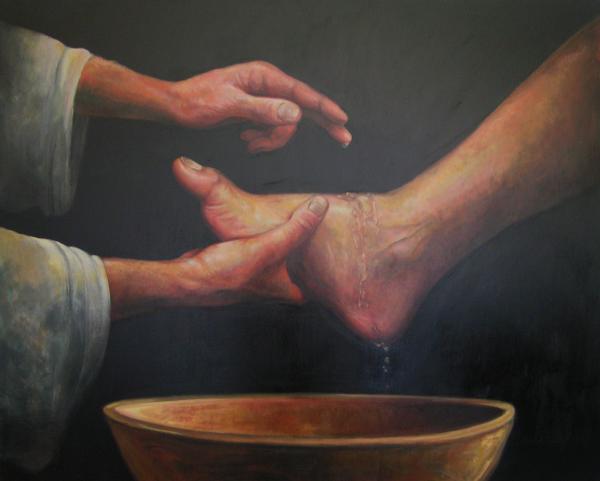
The ways of the Kingdom of God were both taught and perfectly demonstrated by Christ Jesus in His earthly ministry. The stark difference between the Kingdom way of doing things and the earthly or carnal man’s way of operating is notable throughout the many encounters Jesus had with the people in which He interacted. One such episode is described in John 13 as we read about Jesus washing the feet of His beloved disciples. It is obviously an act of humility, servanthood, love, and spiritual foreshadowing. Humility, servanthood, and love are character attributes very necessary as a Kingdom citizen but extremely foreign to an earthly or carnal mindset. I believe that through Jesus’ act of humility, the disciples were given an opportunity to receive more than physical cleansing. The foot washing was a symbol of the ongoing cleansing or sanctification process that Jesus would offer them as they walked in the Spirit and the Word of God. It was not only a prophetic act of consecration, but an invitation and promise of an even deeper covenant relationship, one that would allow them to inherit all that He possessed and all
they needed for their walk ahead. A covenant that only Christ, the Cleanser of our souls, could give them.
I. HE PLANNED AHEAD FOR HUMILITY AND SERVANTHOOD
According to Mark 14:13, Jesus sent two of his disciples ahead to prepare for the
Passover meal. One of the final acts before going to the cross was to wash the feet of his disciples. There was no servant hired to wash the feet of His guests, as would have been expected by tradition. Was this an oversight? No, Jesus said in John 5:19 that He only did what he saw His Father do. There were no ‘coincidences’ in His Life of walking with the Spirit of God. Jesus knew that He would wash the feet of his disciples. He planned ahead to be able to serve them and share this intimate moment with them so that they could witness a crucial kingdom principle that they would be expected to follow. John 13: 3-17 recounts this scenario in the upper room:
“Jesus, knowing that the Father had given all things into His hands, and that He had come from God and was going to God, rose from supper and laid aside His garments, took a towel and girded Himself. After that, He poured water into a basin and began to wash the disciples’ feet, and to wipe them with the towel with which He was girded. Then He came to Simon Peter. And Peter said to Him, “Lord, are You washing my feet?” Jesus answered and said to him, “What I am doing you do not understand now, but you will know after this.” Peter said to Him, “You shall never wash my feet!” Jesus answered him, “If I do not wash you, you have no part with Me.” Simon Peter said to Him, “Lord, not my feet only, but also my hands and my head!” Jesus said to him, “He who is bathed needs only to wash his feet, but is completely clean; and you are clean, but not all of you.” For He knew who would betray Him; therefore, He said, “You are not all clean.” So, when He had washed their feet, taken His garments, and sat down again, He said to them, “Do you know what I have done to you? You call Me Teacher and Lord, and you say well, for so I am. If I then, your Lord and Teacher, have washed your feet, you also ought to wash one another’s feet. For I have given you an example, that you should do as I have done to you. Most assuredly, I say to you, a servant is not greater than his master; nor is he who is sent greater than he who sent him. If you know these things, blessed are you if you do them”. (John 13:3-17, NKJV)
The narrative speaks to Our Lord’s forethought, humility, ability to honor others in
loving service, His submission to the Father, as well as His lack of pride, arrogance, or haughtiness. I find it interesting that the scripture says that the Father had revealed Jesus’s identity to Him. I believe this is key to being able to walk in humility. When we know who we are in Him, we are free from the fear of man and what man may think of us. It is then that we can truly be vulnerable to selflessly love others. The world’s system, which had invaded the priesthood of that day (as well as today’s church structure), seeks to demonstrate superiority, success, and status. Jesus was confident in His relationship with the Father, His disciples, and
His assignment, so much so, that He was able to humble himself and show them the way of the Kingdom.
The Word of God stepped out of the glory that He had with the Father to take on human flesh and become the spotless sacrifice and atonement for the sin of mankind. This, in my opinion, was the most incredible act of humility ever recorded. Knowing that He was to soon go to the cross, He once again disrobes Himself of his earthly glory (removed His outer garment) and humbled Himself. He showed them that not only was He willing to die for them, as the suffering servant, He was going to promise to continue to be with them, cleansing and sanctifying them by washing them with His Word. He was the lamb who would make peace between God and man. He was preparing their feet for the incredible journey ahead of them. He
was preparing their feet to carry the gospel of the kingdom and the message of peace between God and mankind as humble servants of the Lord.
II. HE DEMONSTRATED HOW THE DISCIPLES WERE TO OPERATE
The disciples knew Jesus as Rabi, Teacher, and Master. As their Leader disrobed and washed their feet, the disciples were able to see a side of Jesus that they may not have seen in other leaders or rabis of their day. The Pharisees and the Sadducees were strict in their beliefs and doctrine but according to Jesus in Matthew 23:23 they were hypocrites and showed little mercy or faithfulness. Obviously, the leadership of the day was political, power hungry, and
threatened by the teachings of Jesus. The disciples were acquainted with the ways of the rabbinical structure and attitude, so they must have been amazed at the ways in which Jesus taught, lived, and mentored them. Jesus demonstrated ‘Servant-Leadership’ (a phrase coined by Robert K Greenleaf in his 1970 essay). Jesus was the essential ‘Servant-Leader’. The priests of the day were not servant-leaders. According to history, the Sadducees were upper status elitists and the Pharisees were rigid. It is clear to me in the interactions that Jesus had with the priests that they were very astute in ruling the masses by fear motivation.
1John 4:8 explains that those who do not love, do not know God, for God is love. Verse 18 of the same chapter states that there is no fear in love, but perfect love drives out fear, because fear has to do with punishment. I can draw the conclusion that the priests of the day were motivated by fear, did not know God, and spent time withholding God’s love to the people and even unjustly punishing them. The priests demanded complete obedience to themselves, to their manmade rules, and their unjust practices.
When Jesus washed the feet of His disciples, He showed that He was not afraid of
serving them in a most uncommon way. Jesus showed complete abasing love for his disciples. According to the Jewish Encyclopedia, when entertaining guests in their home, the host would supply water, have a servant wash the feet of the guests or the wife would perform this duty. Withholding this practice would have been considered a great affront to the guests. For Jesus to condescend to perform this task was an incredible act of a Master serving his students. In verse 16 of John 13, Jesus makes the statement that no servant is greater than His Master. Jesus demonstrated this by submitting to the Father in all things. He was admonishing
them to submit to Him in all things and to realize that they were to be servants under His authority from this point on. He showed them that being a servant-leader was the way in which they would be expected to conduct themselves and treat each other. What a difference from the other religious leaders of their day who looked for power, position, and status.
This, unfortunately is not too different from some of the leaders in the body of Christ today who would rather be served than to serve others. When you are washing the feet of your coworkers in Christ, it is very difficult to lord yourself over them, or compare yourself to them. Jesus demonstrated His ability to be vulnerable with them. I believe this is what He asks of us as imitators of Christ. We must not be afraid to be vulnerable to each other. Peter felt uncomfortable with that act of vulnerability and was trying to refuse to be cleansed. When faced
with the kindness of our Lord, we often feel unworthy. We must be able to be continually receive cleansing by our Lord. Walking on the roads of life, we are exposed to all types of dirt, grime, evil, and failure. We are in desperate need of the open door that our God gives us for cleansing, forgiveness, healing, and restoration. All things have been provided for us to be able to walk in
righteousness and holiness in this life.
The Word of God is powerful and as we allow it to penetrate our soul, it cleanses us from all our wrong thinking and provides strength to walk in all that God intends. When Peter refused to be cleansed by Jesus, who is the Word of God made flesh, he was refusing a kingdom provision. Jesus admonished him by telling Peter that if he refused, he would have no ‘part’ with Him. This speaks to me as being critical to our walk. Not only did Peter have to obey the Lord, he had to show his own vulnerability to allow his master to perform such a menial but necessary task. Many people find is easy to serve, but more difficult to be served. We, as His Body, must
be able to both give and receive. It takes humility and vulnerability to do both. Washing the feet, or performing sacrificial tasks, for our leaders, servants, family, friends, and our enemies is a perfect example of demonstrating the important Kingdom principle of humility, vulnerability, and servant-leadership.
III. HE PROMISED A MORE INTIMATE COVENANT
The last point that I want explore is the prophetic picture of what Christ would do for those who would receive cleansing by the Word of God. Jesus understood that going to the cross would not only atone for the sin of mankind, but it would become the vehicle for Him to be resurrected, glorified, and to wear the victor’s crown. Jesus was showing the disciples that to attain this reward, they would have to covenant with Him in a deeper way. To explain my meaning, I refer to the teaching of John Klein and Adam Spears in their book of Hebrew foundations, “Lost in Translation, Rediscovering the Hebrew Roots of Our Faith”. Klein and Spears discuss the 4 major Patriarchal Covenants:
Blood (Service)
Salt (Friendship)
Sandal (Sonship/Inheritance)
Betrothal (Marriage)
Jesus called his disciples friends in John 15:15. He was trying to explain that relationship is progressive, as are the covenants that God makes with us. Each covenant is better than the one before just as the New Covenant, a permanent contract made by the blood of Christ, is better than the Old Covenant, a temporary contract, made by the blood of bulls and goats. In these passages in John 15, Jesus established that He now considered his students, not as mere servants, but friends. His disciples had moved from Service to Friendship. In the scenario of the foot
washing, the prophetic picture, in my opinion, is an invitation to an even greater covenant or relationship with God…Inheritance.
John 15:13-17 (ESV)
“Greater love has no one than this, that someone lay down his life for his friends. You are my friends if you do what I command you. No longer do I call you servants, for the servant does not know what his master is doing; but I have called you friends, for all that I have heard from my Father I have made known to you. You did not choose me, but I chose you and appointed you that you should go and bear fruit and that your fruit should abide, so that whatever you ask the Father in my name, he may give it to you. These things I command you, so that you will love one another”.
The Sandal Covenant was seen when God invited Moses to approach the burning bush and take off his sandals. In this meeting, God revealed his desire to covenant with Moses so that He could deliver Israel and create a nation unto Himself, a nation of kings and priests in the earth. Moses was given the Torah and this set a course that is still in effect today. Moses did not inherit the promise that God made with him, but King David did and Jesus fulfilled the promise. It is clear to me that Jesus, removing their sandals and washing their feet, was offering them
something more. It was a similar offer for a friend to become a son who inherits.
Jesus told Peter that if he rejected this covenant offer, he would have “no part” with Him. When a son, who is one of many sons receives an inheritance, he receives part of his father’s estate. I believe Jesus was offering them a new inheritance…part of His own. They would no longer be servants or friends but the promise of adoption was being foreshadowed. They would receive the right to become children of God and joint-heirs. All that Christ was to inherit from His death and resurrection would be made available to them.
If we, as servants of God seek more, He will come to offer friendship. If we are friends, then we may be invited to become sons. By allowing ongoing cleansing and intimate relationship with the Word of God and the Spirit of God, we can inherit the fulness of the Kingdom promises. God is so good! He doesn’t stop there. For those who allow the Sandal Covenant, there is a promise for the next step…the Betrothal or Marriage Covenant. In this Covenant relationship, we are able to partner with God as a wife partners with her husband in life. What a wonderful progression of promises.
CONCLUSION
In the simple sacrificial act of Jesus washing the feet of His disciples, we see so many principles represented. This is not surprising as our God is unfathomable to comprehend. He is able to convey in one act: Heart posture of a true leader, Love; Humility; Servanthood; Identity; A better covenant; Vulnerability; Accepting kindness graciously; The need for continual cleansing and more as we each receive revelation in the way that the Lord understands our need. The scriptures are alive and continually speak of our need for Christ, the Servant-Leader and
Covenant Maker.
 ShiloMinistries
Amen!
<
div dir=”ltr”>
<
blockquote type=”cite”>
LikeLike